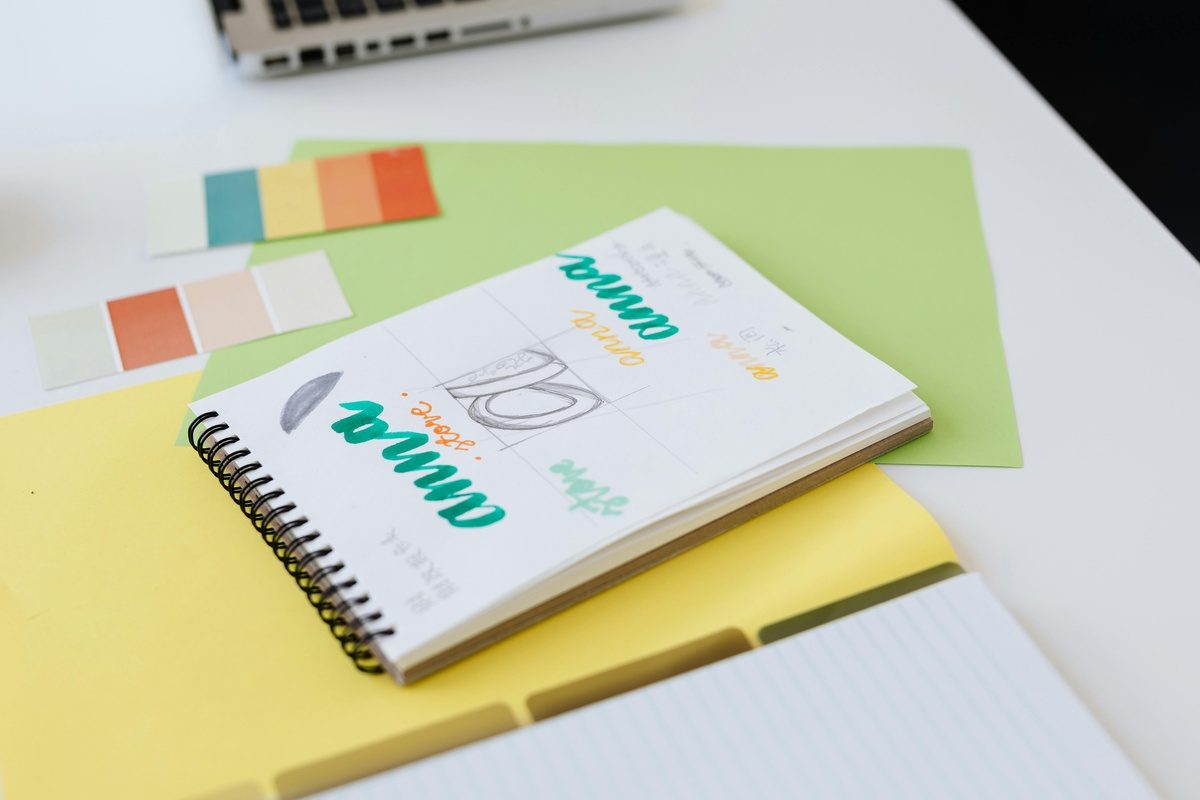
A logo project lives or dies by the quality of the brief.
A designer who doesn't understand your business, your customers, or your market can't design something that actually serves you — no matter how talented they are. A vague brief produces generic output. A specific, thoughtful brief gives a designer the raw material they need to create something genuinely useful.
The good news is that you don't need to know anything about design to write a strong brief. You just need to know your business — and be willing to articulate it clearly.
This guide covers the ten things to include, the things to avoid saying, how to create a moodboard, and what happens next.
Why Briefing Properly Matters
Most design project frustrations come down to a gap between what the client imagined and what the designer understood. That gap is almost always bridged — or created — by the brief.
A strong brief:
- Reduces the number of revision rounds needed
- Saves time for both you and the designer
- Produces a logo that actually works for your business, not just one that looks good
- Means fewer surprises and more confidence on both sides
- Protects your budget — every revision round that results from a misunderstanding is a round that could have been avoided
A weak brief — or no brief at all — is how you end up with three rounds of concepts, none of which feel right, and a designer who's frustrated because they're guessing what you want.
The 10 Things to Include in a Logo Brief
1. Your business name and what you do
State your business name exactly as you want it to appear (including capitalisation, any abbreviations, and whether you want an icon, wordmark, or combination). Then describe what you do in plain language — not what industry you're in, but what you actually provide and who you provide it to.
Don't write: "We're a professional services company." Write: "We're a two-person bookkeeping practice based in Geelong, working with hospitality businesses and sole traders. We help small business owners stay GST compliant and actually understand their numbers."
2. Your industry and competitive landscape
Name your main competitors — local ones especially. Show the designer their branding. Tell them what you like about it (if anything) and what you want to clearly differ from. A designer can't research your local market the way you know it.
This is also where you tell them about any industry visual conventions: trades businesses often use bold type and strong primary colours; healthcare leans towards blues and greens; luxury brands favour black, gold, and white space. Do you want to follow convention (which signals belonging to an industry) or deliberately differentiate?
3. Your target audience
Describe the people you want to attract. Not just demographics — age, location, occupation — but what they care about, what they're wary of, and what makes them choose one provider over another. A logo for a childcare centre targeting young families needs to land very differently from one for a commercial HVAC contractor targeting facilities managers.
4. Your brand personality
Choose three to five adjectives that describe how you want your brand to feel. These are the words a customer should use when they see your logo and think about your business. Common examples:
- Professional, reliable, established (common for trades and professional services)
- Modern, fresh, innovative (tech, creative, or specialist services)
- Warm, approachable, community-focused (healthcare, childcare, local retail)
- Bold, confident, premium (luxury services, high-end B2B)
Be specific. "Professional" and "trustworthy" are very common starting points — push beyond them to what makes your particular personality distinct.
5. Your competitors' branding (what to stand out from)
This follows on from point 2, but is worth its own entry. Show the designer screenshots or links to competitors' websites and logos. Be explicit: "I want to look clearly different from these three companies" is incredibly useful direction. "I like the way this company looks" — even if that company is in a completely different industry — is equally valuable.
6. Your visual preferences
What styles appeal to you? Some useful dimensions to consider:
- Minimal / detailed: Clean and simple with lots of white space, or more intricate and complex?
- Geometric / organic: Hard angles and precise shapes, or curves and hand-crafted elements?
- Modern / classic: Contemporary and current, or timeless and established?
- Type-led / icon-led: Wordmark that lives in the typography, or a symbol that can stand alone?
- What you actively dislike: Just as important as what you like.
7. Colour preferences (and any restrictions)
Do you have strong colour preferences or aversions? Any colours associated with competitors you want to avoid? Are there brand colours already in use (e.g., your website is built in a particular palette) that the logo needs to work with?
You don't need to specify exact colours — that's the designer's job. But "I want something warm and earthy, no blue, definitely not corporate navy" gives very useful direction. If your industry has colour conventions (safety yellow for electrical, plumbing blue, healthcare green) mention whether you want to lean into them or differentiate.
8. Where the logo will be used
This is the practical brief that shapes design decisions. Tell the designer every application you can think of:
- Digital: Website, social media profiles, email signatures, digital ads
- Print: Business cards, letterheads, flyers, brochures
- Signage: Shop front, directional signage, A-frames
- Vehicles: Ute door, van wrap, trailer
- Uniforms: Embroidery on polo or hi-vis shirt, screen printing on a t-shirt
- Merchandise: Caps, bags, mugs, stickers
Embroidery, for example, can't handle fine lines or gradients — a logo designed for embroidery needs to be simpler. A vehicle wrap logo needs to work at very large scale. Knowing the applications shapes the design from the start, not as an afterthought.
9. File format requirements
If you know you'll need specific formats, say so: vector source files (AI, EPS, SVG), PNG with transparent background, JPEG. Also ask for colour variants if not included as standard: full colour, reversed/white for dark backgrounds, and black and white for single-colour applications.
A professional designer will provide all of these as a matter of course. But stating your needs upfront confirms you're both on the same page from the start.
10. Budget and timeline
Be honest about both. A designer who knows your budget can tell you immediately whether they can deliver what you need at that price — or whether expectations need adjusting. A designer who doesn't know your budget may spend time developing concepts that don't match what you can afford.
Likewise, if you have a hard deadline (you're launching the business on a particular date, you need the logo before a trade show), say so upfront. Most professional logo projects take two to three weeks from brief to final files, with revisions.
What NOT to Say in a Logo Brief
"Make it pop." This communicates nothing useful to a designer. What do you mean by pop? High contrast? Bold colours? Unexpected shape? Be specific about the outcome you want.
"I'll know it when I see it." This is a brief for an infinite revision loop. Designers can't read minds. Give them a direction, even a rough one.
"Something similar to [major brand]'s logo." Referencing Nike, Apple, or Google as inspiration sets unrealistic expectations and often signals that the client wants a symbol that functions like a globally-recognised brand mark — which takes decades and billions of dollars of exposure to achieve, not a logo project. Use references to describe a feeling or aesthetic, not to ask for a copy.
"I want it to appeal to everyone." A logo designed for everyone is designed for no one. Be specific about who you want to attract, and trust that a logo that resonates deeply with the right audience will do more for your business than one that doesn't offend anyone.
Creating a Moodboard: The Most Valuable Thing You Can Do
A moodboard — a collection of images that convey the feeling you want — is worth more than most written briefs. It closes the gap between what you imagine and what ends up on screen.
How to build one:
- Open Pinterest and create a secret board titled "[Your Business Name] Brand Inspiration"
- Search for: your industry + "branding," your industry + "logo," "brand design [adjective]" (e.g., "brand design minimal," "brand design warm earthy"), and general aesthetics that appeal to you
- Pin 15–25 images that feel right — they don't need to be logos, or even from your industry. Interior design images, photography styles, packaging, typography all communicate aesthetic direction
- Share the board link with your designer
The images don't need to be cohesive. Contradictions are useful — they show the designer where you're pulled in different directions, which is something to resolve together.
What Happens After the Brief
A good designer will read your brief, ask clarifying questions, and then present an initial concept or two — not a finished logo, but a direction for you to respond to. Your feedback on the first concept shapes the next round.
The typical process at CodeQy looks like this:
- Brief and consultation: We ask questions, you share your moodboard and answers, we confirm we understand the direction
- Initial concepts: One or two distinct directions, presented with rationale
- Feedback and refinement: You respond, we refine
- Finalisation: The chosen direction is refined to production standard
- Final delivery: Complete file set — vector source files, all formats, all colour variants, plus a brief brand guidelines document
Knowing what to expect means you can engage productively at each stage rather than feeling uncertain about whether the project is on track.
For more on what brand identity involves beyond the logo itself, read: What Is Brand Identity and Why Does Your Small Business Need One?
For more on the full Logo & Branding topic, see our complete guide for Australian small businesses.
Ready to Start?
The best brief is one you actually complete. If you've been putting off commissioning a logo because you weren't sure what to say, this is your starting point: answer the ten questions above, pull together a Pinterest moodboard, and book a conversation with a designer.
Get started with CodeQy's Logo & Branding packages →
CodeQy is a Melbourne-based web design and branding agency serving small businesses across Victoria and Australia. We specialise in logo and branding, websites, and ongoing digital support for local businesses who want to look the part and grow.