Ask most small business owners what their brand is, and they'll point to their logo.
Ask them why they chose those colours, what feeling they want customers to have, or whether their Instagram looks like their business cards — and you'll often get a blank stare.
That's not a criticism. When you're running a business, branding rarely feels urgent. There's always something more pressing: a quote to send, a job to finish, a staff member to manage. The logo gets done quickly — sometimes in Canva at 11pm, sometimes via a $99 Fiverr gig — and then it's filed away and mostly forgotten.
The problem is that your brand is working on you even when you're not thinking about it. Every time a potential customer sees your van, visits your website, or lands on your Instagram page, they're forming an opinion. A strong, consistent brand makes that opinion positive. An inconsistent or amateurish one undermines you before you've said a word.
This guide covers everything Australian small business owners need to know about logo design and brand identity in 2026 — what things cost, what you actually get, and how to make decisions that serve your business for years rather than months.
Why Your Logo Is Not Your Brand (But Both Matter)
This is the most important thing to understand before you spend a dollar on design.
Your logo is a mark. It's a visual symbol that represents your business — a wordmark, an icon, a combination of both. When it's done well, it's distinctive, versatile, and memorable. It works at the size of a business card and at the size of a billboard. It looks right on a dark background and a light one.
Your brand is everything else. It's the sum total of how your business looks, sounds, and feels at every point of contact with a customer. Your brand includes:
- The colours you use and what they say about you
- The fonts that appear in your marketing materials and website
- The way you write — formal or casual, technical or conversational
- The photography style on your website and social media
- The experience of calling your office, visiting your shop, or opening your packaging
- The values and personality that come through in every interaction
A logo without a brand behind it is just a sticker. A brand without a strong logo lacks a visual anchor. The two work together — but they are not the same thing.
Why does this matter practically? Because a lot of Australian small businesses spend $200 on a logo, call it "done," and then wonder why their marketing doesn't seem to connect. The logo was just one piece. The rest of the system — colours, fonts, tone, imagery — was never defined, so everything looks inconsistent, and inconsistency is the enemy of trust.
Research backs this up: 75% of consumers recognise a brand by its logo, and 60% identify a brand by its colour alone. More significantly, consistent brand presentation across all channels can increase revenue by up to 23%. That's not a small number for a business turning over $500,000 a year.
What Does a Logo Actually Cost in Australia?
The honest answer is: it depends enormously on who you hire and what you need. But the range is far wider than most people assume — in both directions.
We cover the full breakdown in our dedicated guide How Much Does a Logo Cost in Australia?, but here's the summary for 2026:
Prices current as of 2026.
A few things worth noting:
Cheap doesn't always mean bad — some excellent Australian designers offer competitive rates, especially those who focus specifically on small businesses. The question is always what you're getting for your money.
Expensive doesn't always mean better — a $10,000 logo from an agency that doesn't understand your market will serve you worse than a $600 logo from a designer who took the time to understand your customers.
The hidden costs of a bad logo are often larger than the cost of getting it right. Reprinting business cards, van wraps, and signage after a rebrand costs easily $2,000–$5,000 for a tradie. Getting a JPEG recreated as a proper vector costs $150–$400. A forced rebrand after a copyright dispute can run to $10,000 or more.
At CodeQy, our Logo & Branding packages start at $200 for a complete logo package — custom design, all vector source files, copyright transfer on final payment, and colour variants for light and dark backgrounds. It's not a template. It's designed specifically for your business by our Melbourne team.
What Is Brand Identity and What Does It Include?
Brand identity is the visual and verbal system that makes your business recognisable. A logo is part of it, but a proper brand identity is a toolkit — a set of rules and assets that ensures your business looks and sounds consistent across every touchpoint.
Here's what a complete brand identity typically includes:
1. Logo system Not just one logo, but a family: your primary logo, a horizontal version, a stacked version, and an icon or brandmark on its own. Different contexts call for different lockups — a square icon works on a website favicon; a horizontal version works on a van door.
2. Colour palette Your primary colours and secondary colours, specified precisely — HEX codes for web and digital, RGB values for screen display, CMYK for print, and Pantone references for exact colour matching on signage and merchandise. Guessing at colours is how you end up with a logo that looks slightly different on your business cards, your website, and your van.
3. Typography A primary typeface for headings, a secondary typeface for body copy, and rules for how they're used together. Typography is more powerful than most people give it credit for — it communicates personality instantly. A rounded sans-serif says something completely different about your business than a sharp serif.
4. Tone of voice How your brand sounds in writing. This covers the language you use, the level of formality, how you handle humour, and how you communicate with customers. An NDIS support provider's tone is very different from a craft brewery's — both are intentional choices.
5. Imagery style The visual direction for photos and graphics in your marketing. Bright and lifestyle-focused? Dark and moody? Clean product shots on white? Candid behind-the-scenes? Consistency in imagery is what makes your Instagram look curated rather than random.
6. Patterns, textures, and graphic elements Supporting visual devices — background patterns, icon sets, dividers, illustration styles — that reinforce the brand's personality and give designers something to work with beyond the logo itself.
7. Brand guidelines document The rulebook that ties it all together. Without it, every designer, printer, and social media manager who touches your brand is guessing. With it, your brand stays consistent whether you're ordering uniforms, building a new website, or briefing an Instagram manager.
You don't need all of these on day one if you're just starting out. But knowing what a complete identity system looks like helps you understand what you're working towards — and avoid locking yourself into choices that don't scale.
Canva Logo vs Professional Logo Design: The Real Difference
Canva has become the default starting point for small business logos in Australia, and it's easy to understand why. It's free, it's fast, and the results look passable on a phone screen.
But there are three fundamental problems with Canva logos that catch small business owners off guard — often at the worst possible time.
1. You don't own it
This is the one most people don't know about until it's too late.
Canva retains ownership of the templates, graphic elements, fonts, and design assets on their platform. When you create a logo using their elements, you receive a non-exclusive licence — meaning thousands of other businesses can use the exact same elements, legally, without any recourse.
More importantly: Canva's own terms of service prohibit you from trademarking any logo that incorporates their platform elements. Only basic shapes, lines, and your own text are exempt. If you ever want to register your brand as a trademark to protect it legally, a Canva logo built from their design library won't qualify.
2. You can't scale it properly
Canva exports raster files — PNG and JPEG. These are pixel-based images with a fixed resolution. They look fine at small sizes on screen, but when your signwriter, vehicle wrap installer, or printer asks for a vector file (AI, EPS, or SVG), you won't have one.
A raster logo enlarged to fit a 3-metre shop sign produces a blurry, pixelated mess. To fix it, a designer has to recreate your logo from scratch — which costs money and time that wouldn't have been needed if the original file had been a vector.
3. It's not actually unique
Every Canva template is available to every Canva user. Swap in your business name and change the colours, and you've got a logo that shares its structural DNA with thousands of others. You might already share a logo with a business down the street — you'd never know.
Here's a direct comparison:
Our honest take: Canva is fine for social media graphics, flyers, and presentations. For a logo you'll put on a van, a shop front, a uniform, and a website — and live with for the next decade — a professional designer is the right call.
How to Brief a Logo Designer
The quality of your brief directly determines the quality of the logo you get back. A designer who doesn't understand your business, your customers, and your market can't design something that actually serves you — no matter how talented they are.
Here's what a strong logo brief includes:
Your business basics What do you do? Who do you do it for? What makes you different from competitors? Don't just say "we offer quality service" — every business says that. Be specific: "We're a female-owned electrician business targeting residential clients in Melbourne's inner north, competing against large franchises on personal service and responsiveness."
Your target audience Describe the people you want to attract. Age range, values, what they care about, what they're wary of. A logo for a children's party hire company needs to land differently to one for a commercial cleaning business.
Your brand personality Choose 3–5 adjectives that describe how you want your brand to feel. Professional but approachable? Bold and contemporary? Trustworthy and established? Playful and irreverent? These words guide every design decision.
Your competitors Name them. Show examples of their branding. Tell the designer what you like about them (if anything) and what you want to be clearly different from. Designers can't research your local market the way you know it.
Your visual preferences What styles appeal to you? Are you drawn to minimal and clean, or detailed and illustrative? Geometric or organic shapes? Modern sans-serif type or classic serif? What do you actively dislike? It helps to show examples — pull 5–10 images from Google or Pinterest that give you the right feeling, even if they're from completely different industries.
Your practical needs Where will the logo appear? Website, social media, vehicle wraps, signage, uniforms, embroidery, merchandise? A logo that works beautifully on a business card might not embroider well if it has fine lines or gradients. Tell the designer what you need so they can design accordingly.
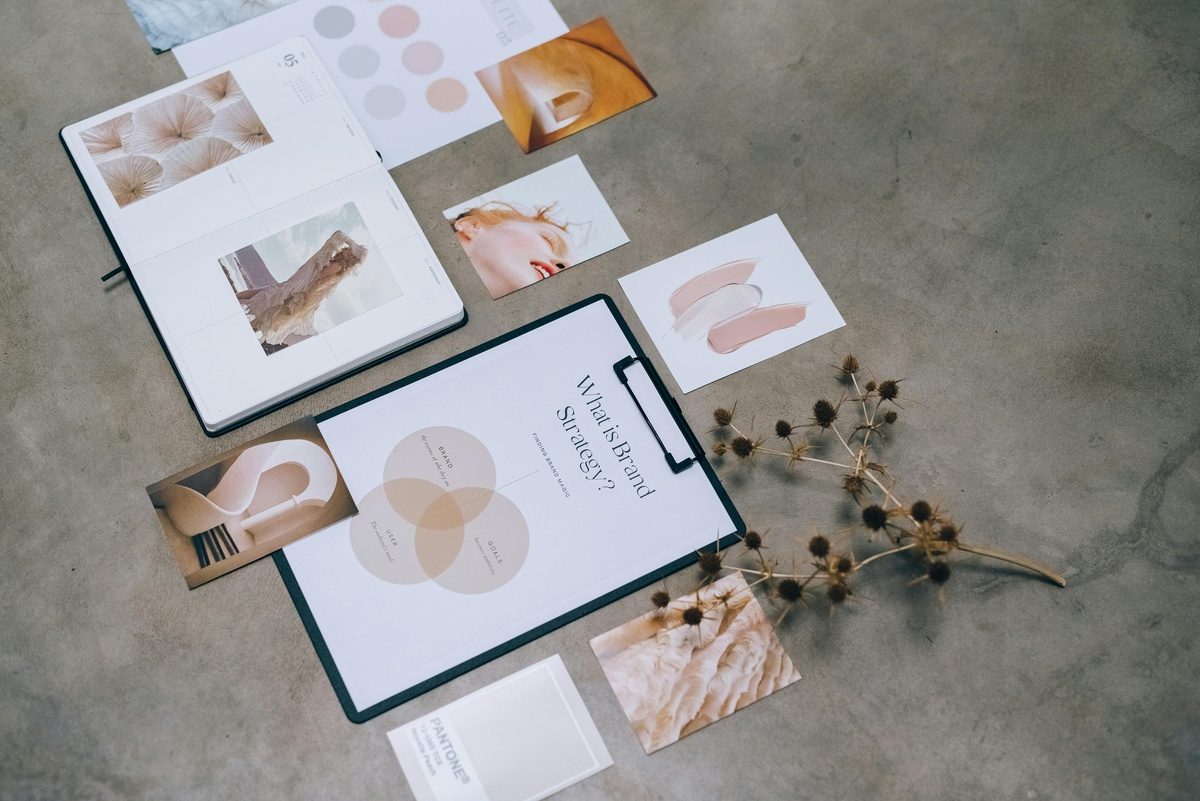
A good moodboard — even just a folder of images you've pinned — is worth more than 10 paragraphs of written description. It closes the gap between what you imagine and what ends up on screen.
The 7 Elements of a Strong Brand Identity
If you're working with a designer or building your brand identity systematically, here are the seven elements that every strong brand has locked down.
1. Logo system A primary logo plus two or three alternative lockups (horizontal, stacked, icon-only). Your logo needs to work everywhere — app icons, embroidery, street signage, a 5mm email signature — and different layouts serve different contexts.
2. Colour palette Three to five colours maximum. One dominant, one or two supporting, one neutral. Specify every colour in every format you'll ever need: HEX (web), RGB (digital screens), CMYK (print), and Pantone (exact colour matching for merchandise and signage). Colour builds recognition fast — research shows 60% of consumers recognise a brand by colour alone before they see a logo.
3. Typography Two typefaces is usually enough. One for headings and display (where personality shows), one for body copy (where readability counts). Define the rules: sizes, weights, spacing, what's used for what. Good typography is invisible when done right and immediately noticeable when done wrong.
4. Imagery style A brief photography and visual direction that defines what "on-brand" looks like. This is what separates an Instagram that looks consistent and intentional from one that looks like a random assortment of photos. Lighting style, subject matter, editing approach, colour temperature — all of it contributes.
5. Tone of voice Brand voice guidelines don't need to be lengthy. Even a single page defining your brand's personality, writing style, and a few "we do / we don't" examples will dramatically improve the consistency of everything your business publishes — from website copy to quote emails to social captions.
6. Graphic elements and patterns Supporting visual devices that extend the brand beyond the logo: custom icon sets, background textures, dividers, illustration styles. These are the details that make a brand feel considered and complete rather than just "a logo on a white page."
7. Brand guidelines document The document that brings all of the above together. Without it, your brand will drift every time a new person touches it. With it, anyone — a new designer, a social media manager, a printer — can represent your brand correctly without having to ask. It doesn't need to be a 60-page behemoth; a 10-page PDF covering the essentials is more useful than nothing.
When Should You Rebrand?
Rebranding gets talked about as though it's always a major undertaking — and at the enterprise level, it is. For small businesses, it's usually simpler: a logo refresh, some updated colours, and a more consistent approach across platforms.
The question is knowing when it's actually time.
Signs it's time for a rebrand:
- Your logo was made in Canva or by a cheap Fiverr gig and you're genuinely embarrassed to put it on a formal quote, a tender submission, or a large-format sign. If your brand is holding you back from going after bigger work, it's time.
- You only have a JPEG. If you can't provide vector files to a signwriter or printer, you effectively don't have a usable logo. This is more common than you'd think — it's a problem that needs fixing before you grow any further.
- Your business has pivoted or niched down. The brand you built as a "general handyman" doesn't serve you now that you specialise in commercial fit-outs. The brand you built as a solo bookkeeper needs rethinking now that you have four staff and are targeting medium-sized businesses.
- Nothing looks the same. Different logo on your website versus your van versus your invoices versus your uniform. Different colours, different fonts, different feeling. Your brand has drifted and customers are getting mixed messages.
- You're consistently being confused with a competitor. Similar colours, similar name, similar aesthetic — customers are misdirecting attention because there's no strong visual differentiation.
- You're moving upmarket. If your old brand positions you as cheap and you're now competing on quality, the brand has to shift. Price anchoring is real — a premium brand commands premium rates.
A general rule: most businesses benefit from a brand refresh every 5–7 years. Not a full rebrand (unless something fundamental has changed), but an update that keeps the brand feeling current without abandoning the recognition you've built.
What does a rebrand actually cost?
For small Australian businesses, a logo refresh with an experienced boutique studio typically runs $1,500–$5,000. A fuller rebrand — new logo, colour system, typography, and guidelines — is $3,000–$10,000 at a specialist small-business studio. Larger agencies with more strategic depth start at $15,000 and scale up significantly from there.
The risk of rebranding is real: you're walking away from the recognition you've built, which takes time to rebuild. Don't rebrand just because you're bored with your logo. Do rebrand when the current brand is actively working against your business goals.
DIY vs Professional: The Honest Comparison
There's a version of this section that just says "always hire a professional" — but that's not genuinely useful advice for a sole trader who's two months into business and needs something serviceable today.
Here's the honest framework:
DIY is fine when:
- You're pre-revenue or in early testing mode and the brand genuinely doesn't matter yet
- You're making something purely for social media content that doesn't go on physical materials
- You already have a professional logo and just need supporting graphics (banners, social tiles, etc.)
- Your budget is genuinely zero and you understand you'll need to replace it later
Hire a professional when:
- Your logo needs to go on signage, vehicles, uniforms, or printed materials (you need vectors)
- You're quoting for commercial work or tendering on contracts
- You want to trademark your brand
- You're launching properly and want to be taken seriously from day one
- Your current brand is actively costing you customers or work
- You've outgrown what you started with and you know it
The most expensive thing isn't paying a professional upfront. It's paying to fix a DIY logo later — reprinting materials, recreating source files, rebranding after a dispute — while also absorbing the opportunity cost of appearing less professional than you actually are.
What about AI logo generators?
Tools like Looka and Tailor Brands have improved significantly and now produce logos that look reasonably polished at first glance. But they face the same core limitations as Canva: the underlying assets are shared across thousands of users, trademarking is problematic, and the "design" is really algorithmic combination rather than considered thought about your specific business and market.
They're worth knowing about. They're not worth building your brand foundation on.
How to Choose the Right Brand Designer in Australia
Good designers are everywhere — and so are bad ones. Here's what to look for when you're evaluating options.
Review their portfolio with your industry in mind A designer who produces beautiful luxury hospitality branding might not be the right fit for your industrial services business. Look for work done for businesses similar to yours in tone, industry, or audience. If they've never designed for a tradie, a medical practice, or a retail business (wherever you sit), ask how they'd approach your brief.
Ask direct questions about deliverables Before engaging anyone:
- Do I receive the vector source files (AI or EPS) at the end of the project?
- Who owns the copyright once the final invoice is paid?
- How many revision rounds are included?
- What file formats will I receive?
- Does this include colour variants (full colour, reversed/white, black and white)?
A professional designer will answer all of these without hesitation. Vague answers — or promises that "of course you'll have everything you need" without specifics — are a flag.
Understand the process A good designer asks questions before they start drawing. They want to understand your business, your customers, and what you want the brand to achieve. If someone jumps straight to showing you concepts without a brief, they're designing for themselves, not for you.
Don't choose on price alone The cheapest option is rarely the cheapest in the long run. But the most expensive option isn't automatically the best either. Look for the designer or studio who can demonstrate they understand your market and has a track record of work you'd be proud to put your name on.
Consider working with a local team There's a practical advantage to working with an Australian designer beyond convenience. They understand the local market, local competitors, and the context your brand will operate in. A Melbourne tradie's brand needs to land differently to a brand designed for an overseas market by someone who's never seen a Victorian suburb.
At CodeQy, we're based in Mulgrave, Melbourne. Every brief starts with a conversation — not a template. We've designed brands for trades businesses, beauty and wellness practices, professional services firms, NDIS providers, and more. Our Logo & Branding packages start at $200 and include everything you'd expect from a professional studio: vector files, copyright transfer, multiple colour variants, and a designed-for-you result.
Frequently Asked Questions
How long does a logo design take in Australia? A professional logo project typically takes 2–3 weeks from brief to final files, accounting for concept development, feedback rounds, and revisions. Rush turnarounds are possible at most studios for an additional fee. DIY tools produce something instantly — but as we've covered, "instant" has trade-offs.
Do I need a logo before building my website? Ideally, yes — your logo anchors everything else. Colour palette, typography, and the overall visual direction of your website all flow from the logo. That said, some businesses build a temporary website with a placeholder brand and upgrade later. It's not ideal, but it's not fatal if you know the placeholder is temporary.
Can I trademark a logo designed in Canva? No. Canva's terms of service explicitly prohibit trademarking logos that incorporate their platform elements. If you want your brand legally protected as a trademark — which matters most as your business grows — you need a custom, professionally designed logo where copyright has been clearly transferred to you.
What's the difference between a logo and a brand? Your logo is a visual mark — a symbol, wordmark, or combination of both. Your brand is the full system: logo, colours, fonts, tone of voice, imagery style, and the overall experience of interacting with your business. A strong brand makes your logo work harder; a logo without a brand system behind it is just a sticker.
How often should I rebrand? Most businesses benefit from a visual refresh every 5–7 years — not a full overhaul, but an update that keeps the brand feeling current. A full rebrand is warranted when your business has fundamentally changed (new audience, new market position, post-pivot) or when the current brand is actively working against your goals.
What's the minimum a professional logo should include? At minimum: a vector source file (AI or EPS), SVG for web, PNG with transparent background, JPEG, colour variants (full colour, reversed/white, black and white), and written confirmation that copyright transfers to you. If a designer won't provide these, look elsewhere.
Should I use my own photo in my logo? Generally, no — at least not as the primary logo mark. Logos that incorporate photos don't scale well (try embroidering a face onto a polo) and don't translate cleanly across all the formats a business logo needs to work in. A stylised illustration is different — that's a considered design choice. But a literal photograph as your logo is a practical problem.
How do I brief a logo designer if I don't know what I want? Start with what you know: your industry, your audience, and the feeling you want to create. Then collect 5–10 images from Google, Pinterest, or Instagram that appeal to you — they don't need to be logos or even from your industry. A moodboard of images that "feel right" tells a designer more than most written briefs. From there, a good designer will ask questions to fill in the gaps.
Ready to Build a Brand That Works?
Your brand is the foundation everything else sits on. Get it right and it works quietly in the background for years — building recognition, earning trust, and making every other piece of your marketing more effective. Get it wrong and you're constantly working around it.
Whether you're starting fresh or ready to replace a Canva placeholder with something you can actually build on, the right moment is when you're ready to take your business seriously — and that's usually sooner than most people think.
Ready to create a brand that stands out? View our Logo & Branding packages →
CodeQy is a Melbourne-based web design and branding agency serving small businesses across Victoria and Australia. We specialise in logo and branding, websites, and ongoing digital support for local businesses who want to look the part and grow.